
Failsons

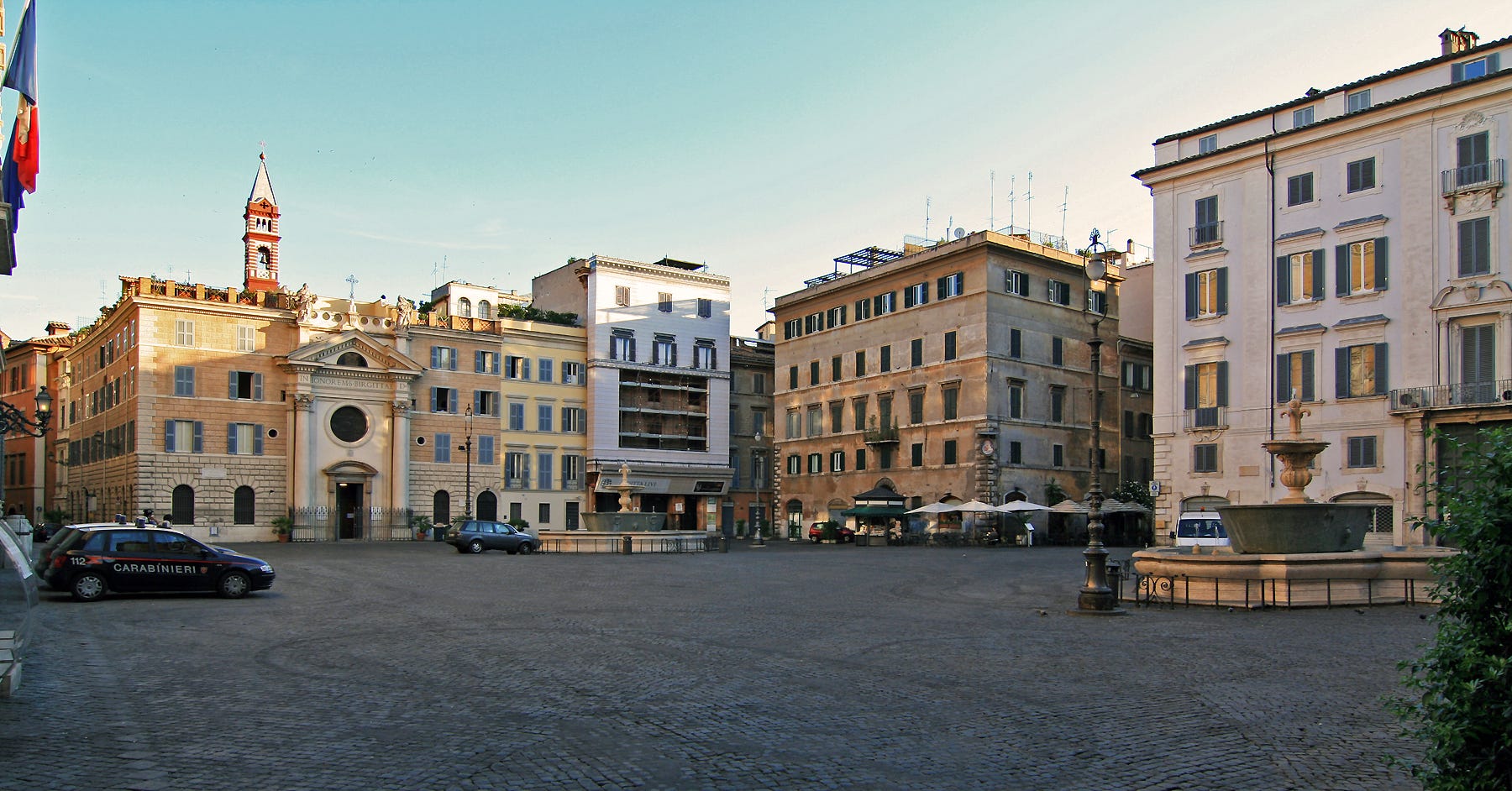
On July 10th, 1973, 16-year-old John Paul Getty III was kidnapped at the main square in the Regola district of Rome. He was taken by an Italian mafia group known as the ‘Ndrangheta, who he may have owed money to. They chained him to a stake inside a cave in Calabria. His grandfather was J. Paul Getty, an oil tycoon and billionaire who was the richest private citizen in the world at the time. John’s captors demanded a $17 million ransom from the family. J. Paul Getty denied the payment, believing his grandson staged his own kidnapping to get money from him. He only budged four months into John’s imprisonment, when the captors cut off his ear and mailed it to the family. J. Paul Getty agreed to pay $2.2 million, because that was the highest amount of cash he could withdraw and still deduct from taxes. In December 1973, John Paul Getty III was found sick and mutilated on a snow-covered highway outside Naples. In 1981, he had a stroke induced by a drug overdose, which left him quadriplegic, partially blind, and unable to speak until his death in 2011.
With the recent buzz around John F. Kennedy Jr., I have thought about what it would be like to be born into a wealthy and powerful family. At birth, you’ve won the lottery. You have all the money and resources in the world. If you want to go into politics or the family business, there’s a seat waiting for you. If you want to do something else, you probably can. The problem is that you’re raised by the types of personalities that run for president and start oil empires. Those who manage to make a name for themselves tend to have a tolerance for cracking skulls and stomping on others. These characteristics don’t make for great parenting or well-adjusted children.

The Getty family’s wealth all came from J. Paul Getty, born in 1892. He inherited his father’s oil business and then bought a 60-year-lease on a “Neutral Zone” desert between Saudi Arabia and Kuwait, which was believed to be barren. His company struck oil there and sold 16 million barrels a year. J. Paul Getty had five children across five marriages. He was largely absent from his kids’ lives and otherwise considered them to be “disappointments.” He didn’t provide significant financial support to them as adults and didn’t attend some of their weddings.
I don’t think J. Paul Getty wanted children. He wanted women, and children were an annoying, grating consequence of those relationships. One of his sons died in a strange incident where he overdosed on alcohol and barbiturates, and also stabbed himself in the chest with a barbecue fork. Another was addicted to heroin as an adult but recovered. Another son died at age 12 from a brain tumor. According to his ex-wife, he gave her a hard time about the amount of money she spent on his treatment. J. Paul Getty was the richest man in the America when he died in 1976. He cut some children out of his will completely, and others’ inheritance was diluted by his mistresses and five ex-wives. His kids entered a years-long legal battle over the estate and ultimately sold Getty Oil in 1984. Getty Oil went defunct in 2012.
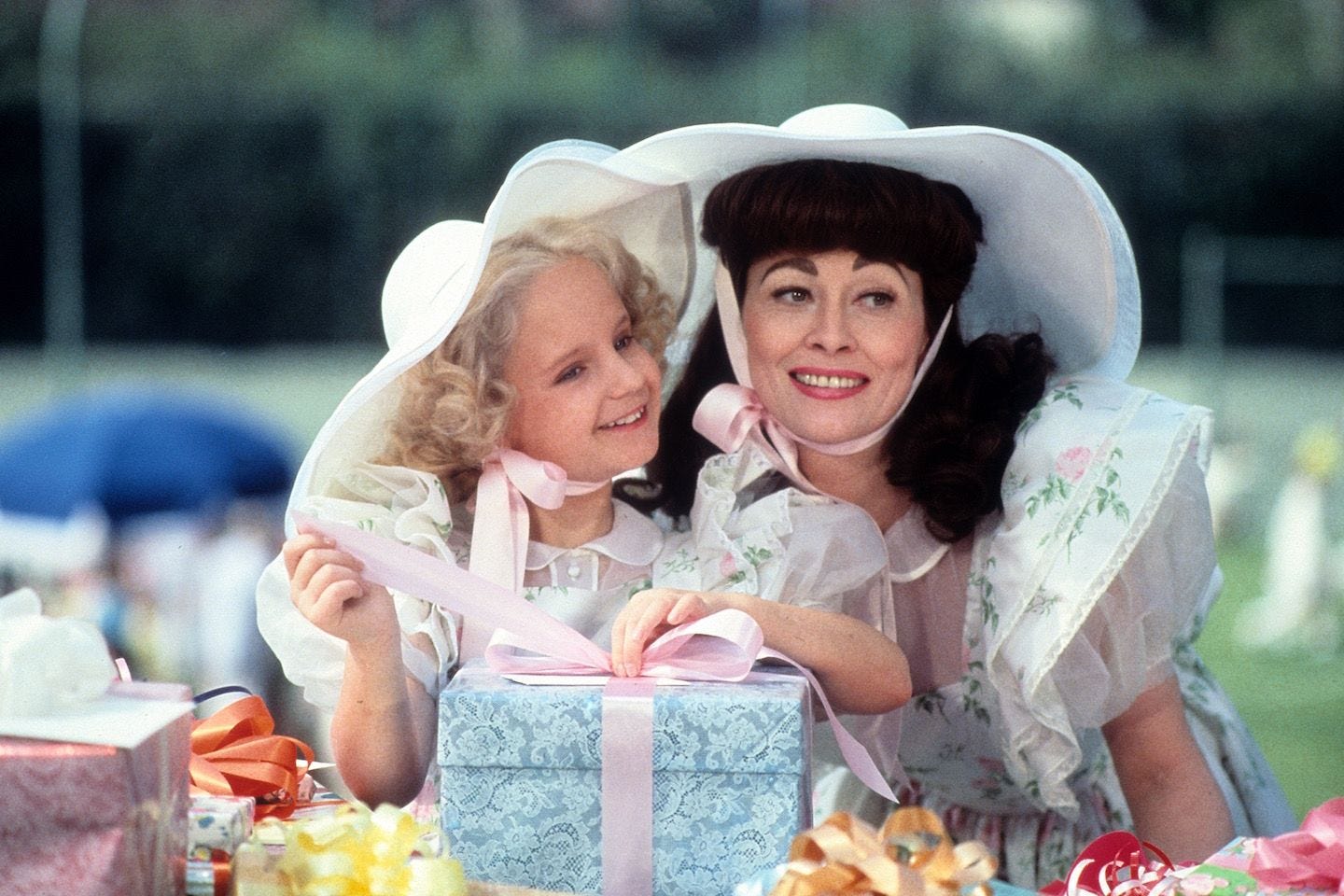
Some luminaries exercise cruelty towards their children, even when they were seeking fulfillment through parenthood. Joan Crawford was the highest-paid actress in the 1930s and 1940s. After a divorce, seven miscarriages, and being labeled “box office poison” following a string of unsuccessful movies, Joan started adopting children. The State of California did not allow single women to adopt, so she paid an adoption brokerage in Las Vegas. The birth mother was a 19-year-old unwed stenographer who gave up Christina and lived with her parents in LA. Joan told Christina that her mother died in childbirth. She found out the truth about her birth mother later in life, but she was dead by then. A few years after adopting Christina, Joan adopted a son and named him Phillip after her then-husband. When she divorced Phillip two years later, she renamed her son, at 3 years old, to Christopher. She also adopted twins.
Joan wanted quiet and well-mannered children, who made her feel flattered in her great taste and hospitality. She made her kids ask if they may speak when they had something to say. She made them write her thank-you notes for gifts. On one incident when Christina didn’t write her a thank-you note, Joan made her stand against the wall for the entirety of an evening mixer event at her school. After high school, Christina moved to New York and was cast in the soap opera The Secret Storm. When Christina spent a week in a hospital for emergency surgery, Joan flew to New York and played Christina’s role in her absence, despite the character being 28 years old. Joan was in her 60s at the time. Joan seemed to soften up with her youngest children, twins Cathy and Cindy. She maintained good relationships with them, and cut Christina and Christopher out of her will.
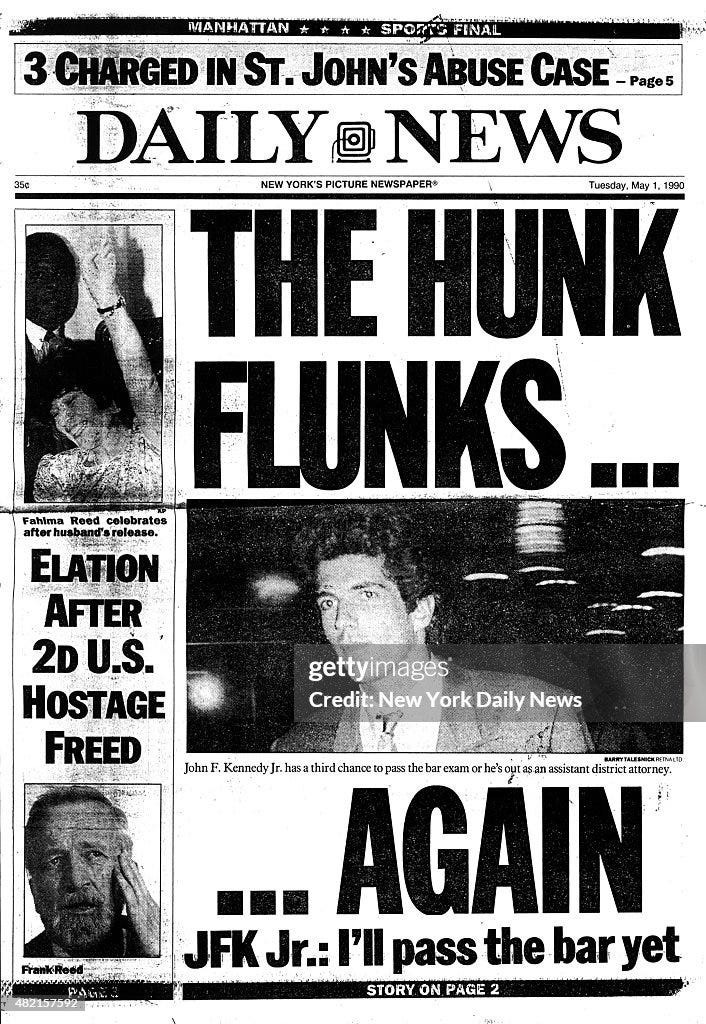
JFK Jr. dealt with a real and perceived pressure to become a lawyer and go into politics, despite not appearing cut out for it. He graduated from NYU Law School in 1989. He failed the bar exam twice before passing on the third try. NYU has a first-time bar passage rate of 97%. He was hired by Manhattan District Attorney Robert Morgenthau, who also hired Andrew Cuomo and RFK Jr. as Assistant District Attorneys. JFK Jr.’s colleagues claimed he was assigned “lock and load” cases, or sure wins. In one case, the defendant was found asleep in his victim’s locked apartment with her jewelry in his pocket. In his four years as an ADA, JFK Jr. managed a total of six cases and won all of them. On average, Manhattan ADAs manage 131 cases a year and have a conviction rate of 66%. JFK Jr. resigned from the Manhattan DA’s office after four years and decided against running for Senate.
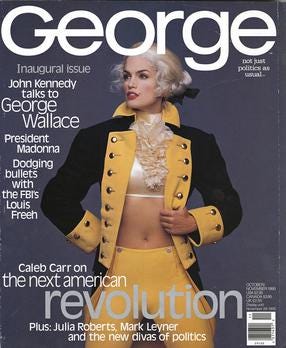
JFK Jr. was trying to carve out a life of his own prior to his death, following a period of extreme surveillance on himself and his marriage. After working at the DA’s office, he started George, a “politics-as-lifestyle” magazine that ran from 1995 to 2001. George had bold, fashionable covers with shots of Cindy Crawford, Arnold Schwarzenegger, and George Clooney. The articles were pretty standard, and unsophisticated, political coverage pieces. Political readers thought the magazine was too frivolous, tabloid readers thought it was boring. George failed to capture an audience and released a final issue with JFK Jr. on the cover, two years after his death.
George was an incomplete concept, but I think it had potential. JFK Jr.’s stated purpose of the magazine was to make politics more accessible to the average reader. At the time, youth voter turnout was very low. The magazine failed to establish some of the ties we’ve identified between politics and day-to-day life - reproductive rights, immigration, employment protections. But maybe with some creative collaboration, it could have gotten there.
Good essay!
That’s the thing about all of these families, when I was younger I used to envy wealthy families like this, because I was squarely “upper lower-class”, but my family has always been close. I didn’t have parents that were striving for political office, or to be CEOs, etc.
And now instead of envying people like this, I actually feel for them.